Brick by brick, slowly but surely, the language barrier is coming down between us and the friendly people of Italy. The hard work that we have invested in learning Italian is allowing us to learn about and go to places that formerly would not have been accessible to us, or within our comfort zone.
We have spent a few lovely days in Puglia, in the boot of Italy. It is an area that sees very few English speaking tourists. For example, we encountered only two Americans during our visit to the very crowded city of San Giovanni Rotondo.
The proprietor of our hotel there told us that he seldom has American guests, and when they do come, they tend to be Spanish speaking Catholics from Los Angeles or Miami. There were no signs in English in the museum dedicated to Saint Padre Pio, and only a few in the church which houses Saint Pio’s body. (However, I admit that I was grateful to the nun who spoke English when I was trying to make an offering and request that a Mass be said for a friend of ours; my Italian was not up to that job! But I will do better next time!)
One other advantage of speaking some Italian is being able to learn about places that Italian people think we should visit. Our waiter at lunch in San Giovanni Rotondo asked us if we were going to visit Monte Sant’Angelo while we were nearby. We had never heard of the place and told him no, we did not plan to go there. But he insisted. It was an “important part of the patrimony of the Italian people” he explained. He told us that it was where the archangel Michael is said to have appeared three times between the years 490 and 493. The city was the site of an important castle dating back to the 800’s. He told us we could easily get there by bus. How could we resist? We found the schedule, bought the tickets, and were off the next morning for a new adventure.
We are so glad we did. Monte Sant’Angelo is high above the Adriatic Sea.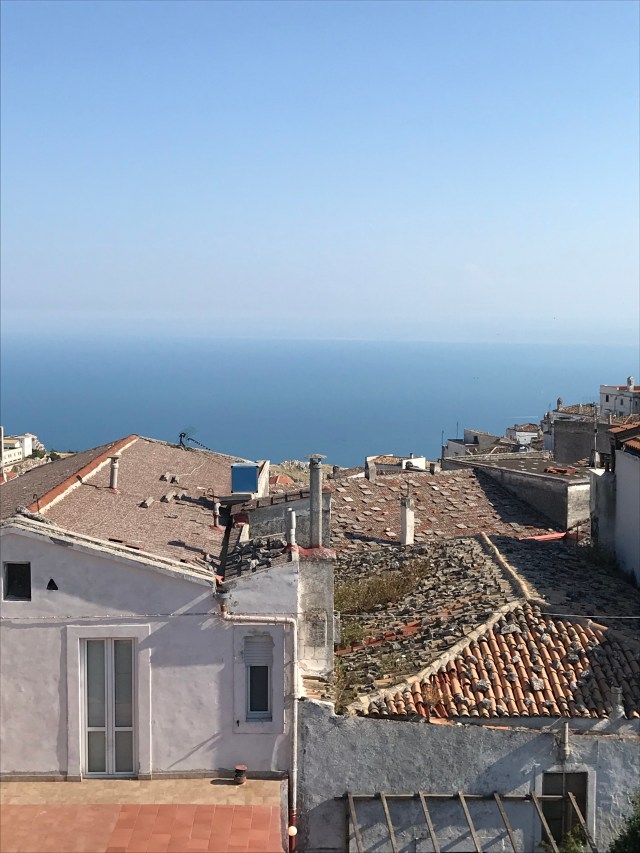 The shrine where Archangel Michael is said to have appeared is in a cave deep in the rock. You reach it by going into a church
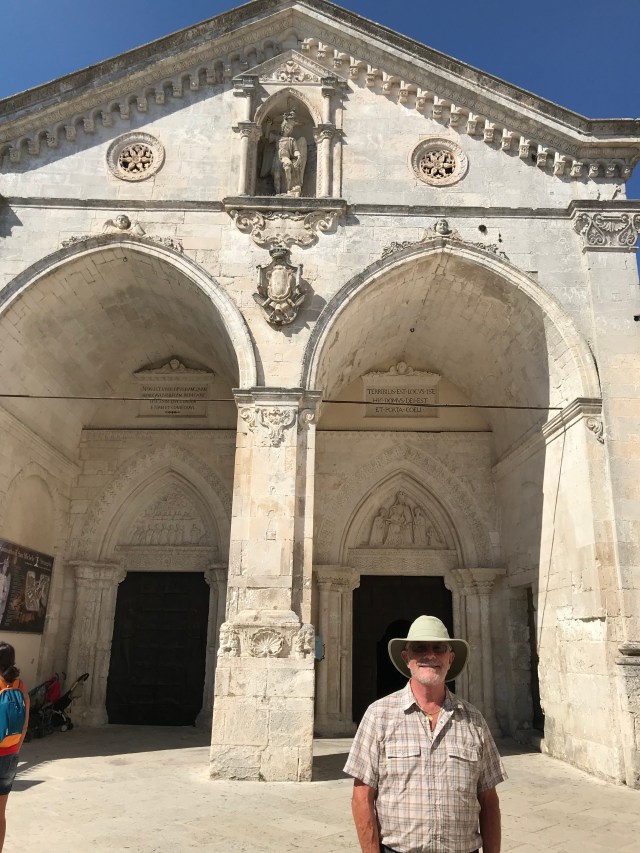 and descending a long staircase.
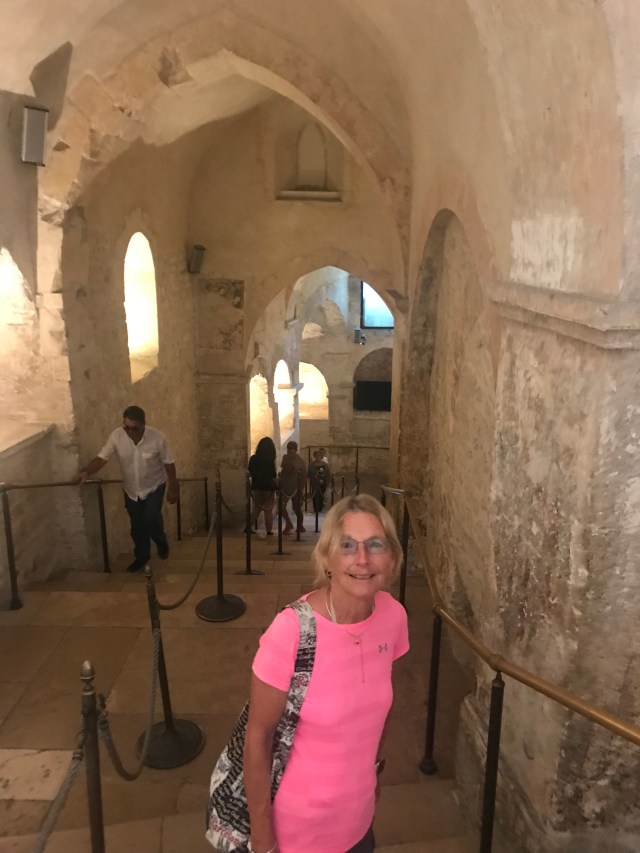 Many people question whether Michael the Archangel, doing battle against Satan, is real. It seems to be part of the popular tradition of the Catholic Church, mentioned in Dante’s Inferno, depicted in important works of art as early as the 4th Century and especially in the Middle Ages. Specific references to an “archangel” named “Michael” are found in the Epistle of Jude and the Book of Revelation in the Bible. Interestingly, Michael is one of two archangels mentioned in the Quran. Also, an angel appeared in a vision to Daniel as described in the Book of Daniel in the Old Testament, who identified Michael (but not specifically an archangel Michael) as a protector of Israel who will rise up in “the time of the end”. Therefore, there are some common threads about Michael in Christianity, Islam, and Judaism. Whatever the literal truth, I found the grotto to be a very holy place, perhaps made more so by the thousands of pilgrims and believers who come each year to pray there.
The castle was quite unusual.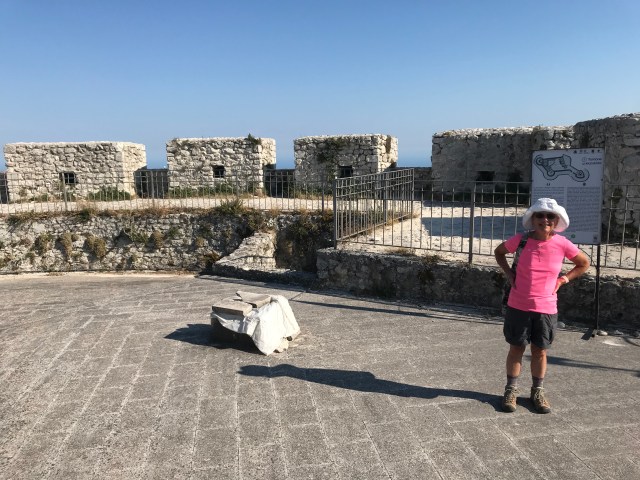 Part of it was shaped like an almond. It was hard to imagine how any army could scale the high walls. The views of the Parco Nazionale di Gargano and the Adriatic Sea from the top of the castle were incredible.
The coastline along the Adriatic Sea is very beautiful. Some of the buildings in Monte Sant’Angelo high above the sea remind me of Greece. Our hotel room had a good view,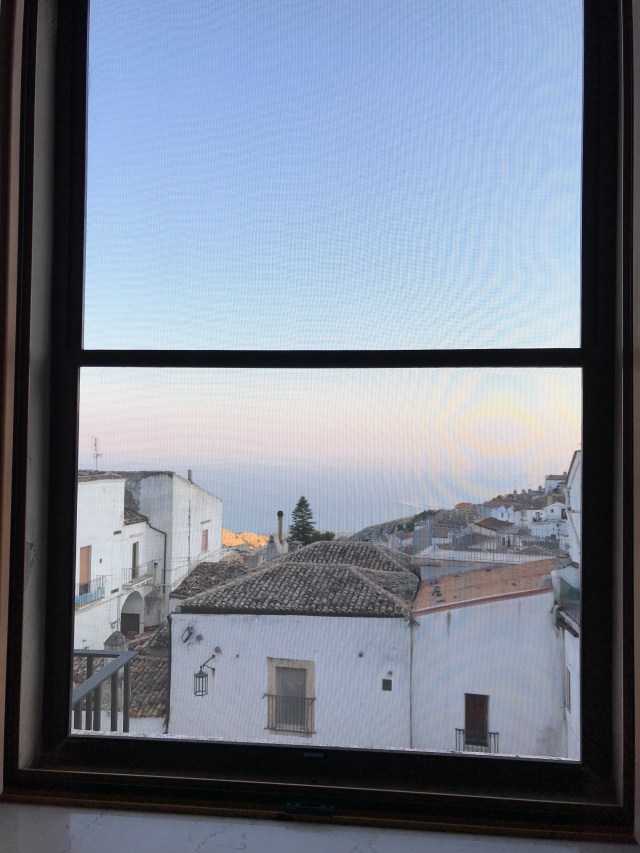 but the view from the hotel’s breakfast room was even better!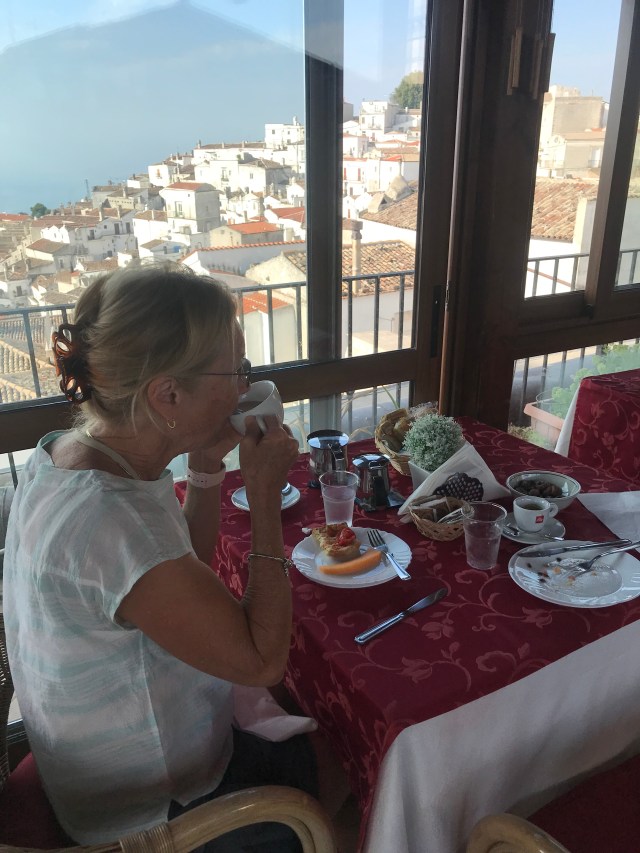
Most of the vacationers in Monte Sant’Angelo are Italian and stroll the streets arm in arm until late at night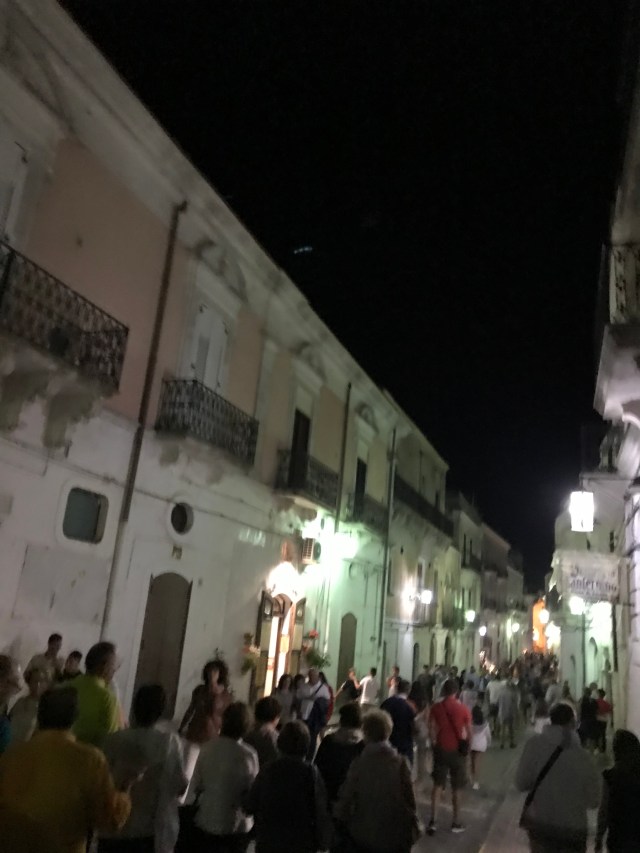 stopping to talk or have an Aperol spritz or a gelato. Karl and I joined right in.
We really enjoyed our time in Puglia.
 ITALY, GERMANY, AND MORE!