The first winery we visited on our tour was Podere le Ripi, which is owned by Francesco Illy, the oldest male in the third generation of the Illy coffee dynasty. I don’t know what Francesco is worth, but IllyCaffé S.p.A. grosses something like $460 million a year. At any rate, he seems to have thrown vast amounts of money at this winery, which he acquired about 20 years ago.
The wine making facility is amazing – a huge round structure with all of the winemaking facilities on a spiral ramp, sort of like the Guggenheim Museum in New York.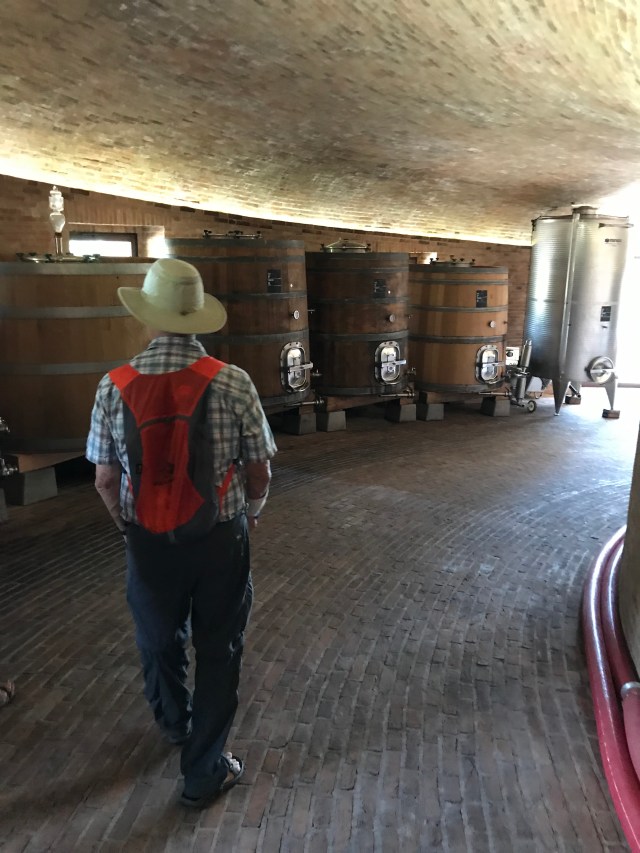
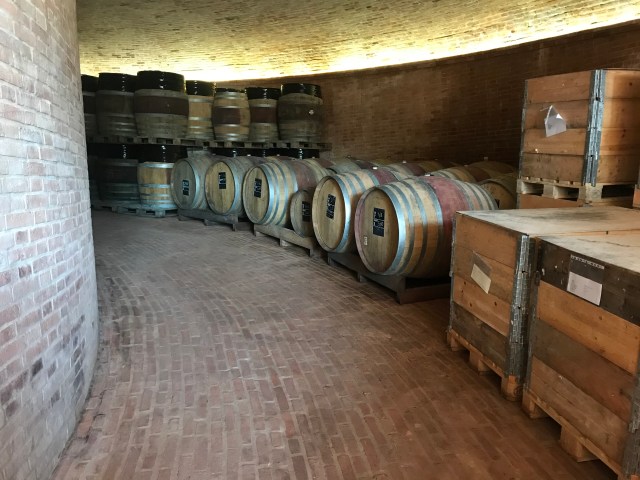 The winery is very big on “Bio” (what we’d call organic) and green. The spiral ramp allows them to start the wine making processes at the top, and, as the wine moves through initial fermentation, secondary fermentation, aging in wood, aging in cement, and aging in bottles, they need very little electricity for pumping as everything flows down hill. It seems that the bottom of the facility is under ground, so they need very little, if any, air conditioning.
The other remarkable thing about this winery is its “Bonsai” vineyards. By law, certified wine in this area such as Brunello di Montalcino cannot be from irrigated vines.
In California, some vineyards are trying to reduce the need for irrigation by planting far fewer than the normal number of vines per acre; fewer vines require less water.
Illy decided to go in the completely opposite direction, experimenting with more and more vines per acre. “Normal” in the area is about 5,000 vines per hectare (something over two acres). Illy is planting as many as 62,500 vines per hectare! This is referred to as Bonsai planting, after the Japanese Bonsai trees.
The theory is that the roots want to spread out horizontally, but, when densely planted, run into other roots competing for the same area. They then go down vertically, deeper and deeper, to get the required water, as far as 20 or 25 meters (60 – 75 feet). In doing so, they also get a lot of minerals they would not find near the surface.
Interestingly, the resulting yield is far lower than the yield from normally planted vines. I think they said they get about 40 – 60% of what they normally would per hectare. Apparently, the vines, having to compete and work so hard to survive, don’t have a lot of energy to put into producing fruit.
But, the grapes they do produce are very small, and have very thick skins, both of which are considered to be ideal for Brunello based wines. We tasted some grapes, and they tasted really rich.
Anyway, Illy can afford a very expensive winery and a very small yield. They had trouble selling their first release in 2004, but deep pockets helped them survive, and they are now producing about 35,000 bottle a year of very successful wine.
Of course, we tasted some of their wine, applying all the things we have been learning in our studies. We felt that the wines, especially the Brunello di Montalcino, were outstanding. Throwing money at some things pays off, especially when you innovate successfully.
 ITALY, GERMANY, AND MORE!